This filter simulates the photopic response of the human eye to relatively bright light. In the plot below, the circles indicate the design targets -- the desired transmission of the filter.
9 r7 g. X" b! Z% c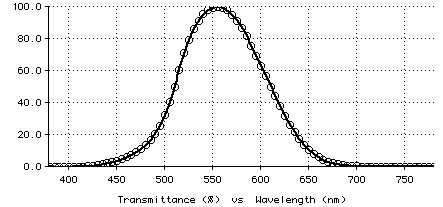
2 _" ^! }7 T `& N) I This design is for normal incidence on a BK7 (ordinary) glass substrate. Two materials are used: SiO2 and TiO2. Starting with a thin, one-layer design, TFCalc's needle/tunneling method produced a sequence of 11 designs of increasing complexity. The design (whose performance is shown above) consists of 32 layers. It matches the entire photopic response curve to within 1%. Phil Baumeister notes that the design can be improved (or simplified) by using a glass whose transmission cuts off near 700 nm. / g) O1 I4 Z3 Y; M7 K- N' B; k/ k
Here is the design, with the first layer closest to the substrate and thickness given in nm:
+ H1 a0 a9 T* W4 y, [- l SIO2 119.328 a. S1 @* E. _, \+ U3 O
TIO2 10.09
1 u$ c/ N$ i z' } SIO2 32.614 F) n% e$ y. J: O
TIO2 79.19 d) K6 T5 |0 ]/ ]7 ]6 s7 Y
SIO2 19.85/ Z; V# P. q' ^
TIO2 9.738 ?/ K! W( W% I
SIO2 118.20
5 [* o$ @* T2 ] TIO2 87.90
+ h4 i; m% }2 C# k SIO2 128.88
- e( W2 L/ I4 w. g* t+ Z TIO2 82.48
7 Y, S) Y$ @% N' t SIO2 121.93
% T2 ^2 l; v& z* w7 @ TIO2 83.91$ ?0 g$ S, Q: x
SIO2 112.35$ k7 Z( i; e( C& ]9 ?( A
TIO2 89.57
% X$ Q' g9 U( Z0 R7 T SIO2 92.26
9 b8 U7 m+ m5 i- L8 T1 \+ q TIO2 66.01! |7 B7 |6 W% _
SIO2 8.09
0 |; K; p2 k) M4 ~# k ^* b TIO2 21.45
3 J6 K& C. u+ K5 E SIO2 103.04" s/ ~( R( I" M4 B: N( K! Y
TIO2 59.41& d) E! S# u' g% k- l: q9 q$ _
SIO2 32.45
: a3 B6 L# j8 ~7 |' D0 d/ L TIO2 15.36) v+ t) h4 g$ r* F- {% c, g/ _
SIO2 98.82
3 }5 g$ h' ~" I# v TIO2 51.98# ` m$ o, \% U/ a; X- [6 q" [
SIO2 77.545 w1 u$ Y3 M$ \6 l5 u* j+ p8 R; k1 a
TIO2 28.263 \* _1 y ?7 U( p2 h G' m# ?
SIO2 68.84
" `0 X8 h1 S0 K0 [ TIO2 49.47/ K2 ~1 F( u. J1 n& u z
SIO2 84.44
+ O) w7 z) ]: X" |+ Y5 V- J TIO2 43.02+ E! z- N u6 U8 \* n. \! {
SIO2 53.15
- n9 y% t$ ~* {. \# L TIO2 39.34 |

 发表于 2007-5-14 21:27:29
 提升卡
提升卡 置顶卡
置顶卡 沉默卡
沉默卡 喧嚣卡
喧嚣卡 变色卡
变色卡 抢沙发
抢沙发 显身卡
显身卡

 窥视卡
窥视卡 雷达卡
雷达卡 发表于 2007-6-25 22:47:34