|
|
[size=+3]Four-Wavelength Bandpass Filter 8 ~) l: L: p5 q+ Z% U& [
[ Contents ] [ Index ] [ Home ]
0 x. ^9 E5 X9 h4 V" B+ tThis idea came from a graduate student who needed a bandpass filter for detecting light at four wavelengths: 630, 690, 760, and 885 nm. Between these wavelengths the filter is allowed to transmit 10%. The filter is to be coated on glass having index 1.52. The filter operates at normal incidence. So that the demo version of TFCalc can be used to design this filter, we use SIO2 and TIO2 as the two coating materials. 3 D; P. F) `& D1 j
We use a total of nine optimization targets: eight discrete targets of 100% transmission at each of the four desired wavelengths ±1 nm and one continuous target asking for less than 10% transmission from 600 to 950 nm. Although it may seem contradictory to have a continuous target that includes the eight discrete targets, it works in TFCalc because each discrete target has the same weight as the entire continuous target.
5 v# P! M0 g0 A- S( f0 SThere is no theory for a bandpass filter of this type. Hence we use TFCalc's needle/tunneling optimization to design the filter from "scratch". That is, we start with one thin layer of TIO2 and have TFCalc grow that layer into a filter meeting the requirements. After a few minutes, TFCalc finds a 21-layer design having the transmission curve shown below.
7 o! z' v7 p v/ x$ q, h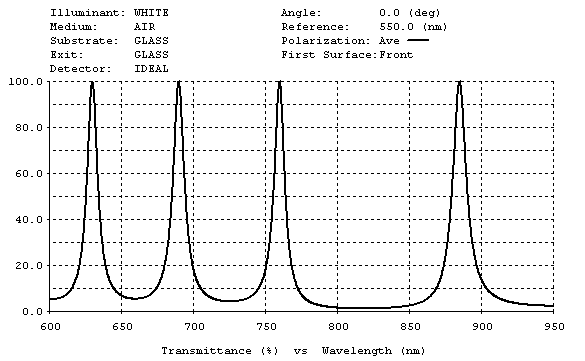
! I v O; E4 t6 d Here is the design with thicknesses given in nm: . H9 b2 z w+ Y" T W. [* a: @
TIO2 75.13' I3 N* }" X& k% Y- r: Z `
SIO2 126.59& G f6 ?. j0 c8 k3 S9 N8 u% s5 g: K& P
TIO2 78.97
8 F0 u$ x- B* X! ESIO2 128.10: h7 h! ]4 w2 n- P
TIO2 79.51; \1 j$ c/ R- I& }! W
SIO2 200.03
5 F* P" H0 ^+ t8 sTIO2 113.53. _) V: b( l6 ?+ V
SIO2 153.01
- ?: f0 A4 V) } F6 d& {3 zTIO2 43.45
* C( @8 l$ O1 B9 d8 G8 O* FSIO2 20.851 R0 a. H# \) G6 C& Z
TIO2 84.08# X" e1 ]% O% k2 f
SIO2 140.53
3 o0 T1 O$ q' y( p4 l2 q8 cTIO2 19.378 _) N* B* b$ r
SIO2 59.24
& ^0 ^8 B: s, e& N3 R. k3 |1 NTIO2 84.74
* I6 f% Z/ k# g9 S% |$ tSIO2 194.559 u, f$ |7 Z1 y$ u- j. `2 k; k
TIO2 122.32, U5 v: D1 I1 M: y
SIO2 128.32# w4 r+ n% F+ c B0 l. E# m5 R
TIO2 79.15
' D! ^; Y/ u8 K4 L Y* VSIO2 127.49- |/ d. H8 P# P* g& m0 H
TIO2 77.77 |
|


 窥视卡
窥视卡 雷达卡
雷达卡 发表于 2010-6-17 02:02:29
 提升卡
提升卡 置顶卡
置顶卡 沉默卡
沉默卡 喧嚣卡
喧嚣卡 变色卡
变色卡 抢沙发
抢沙发 显身卡
显身卡