[size=+3]Broadband High-Reflection Coating at 50 Degrees 6 b# R0 v0 w$ b6 m0 _4 a! \% X
[ Contents ] [ Index ] [ Home ]
6 |* a! W& I* U+ ~, n. k0 zIn the paper, 3 a$ d7 w! l. b
Konstantin V. Popov, J.A. Dobrowolski, Alexander V. Tikhonravov, and Brian T. Sullivan, "Broadband high-reflection multilayer coatings at oblique angles of incidence," Applied Optics, Vol. 36, No. 10, 1 April 1997, pp. 2139-2151.
# O+ I3 @4 q3 _$ K5 U% k) othe authors examine the problem of creating broadband dielectric reflectors using contiguous quarter-wave stacks. It is an interesting paper -- well worth reading if you need to design this type of coating. The following example is taken from the paper.
5 @$ o; T5 A" g, `& f. E5 NThe goal is to design a high reflector which operates in the wavelength range 400-800 nm at a 50 degree angle of incidence. Because this coating is at 50 degrees, the reflectance of S polarization will be much higher than P. Hence, we can concentrate on controlling the reflectance for P polarization. The coating, composed of layers of L (index 1.45) and H (index 2.35), is to be deposited on glass G (index 1.52). The incident medium is air (index 1.0).
! v8 M; t& l5 ~7 M2 y+ M. J: [& BThe formulas in the paper lead to a 3-stack (7 periods/stack) design whose stacks are centered at wavelengths 705, 555, and 437 nm. To increase the reflectance, the authors add one additional H layer next to the substrate. The result is a 43-layer coating whose average P reflectance is 98%.
, z9 T. H- V) B' [1 eTFCalc can be used to design and refine this type of coating. The starting design is a 43-layer coating with the stack formula
6 ?. J* [# w$ nG a(HL)^7 b(H(LH)^7) c(LH)^7 air where H and L represent 1 QWOT (quarter-wave optical thickness) at a reference wavelength of 550 nm and incident angle of 50 degrees, and the factors a, b,and c must be determined using "group" optimization. (This is called group optimization because we vary the thickness of a group of layers; all layers in the same group keep the same relative thickness to the other layer in the group.) Using one continuous target (Rp=100% for 400-800 nm at 50 degrees) and starting values of
j$ T( z* c4 S7 I5 ra = 1.2000, b = 1.0000, c = 0.8000, group optimization finds
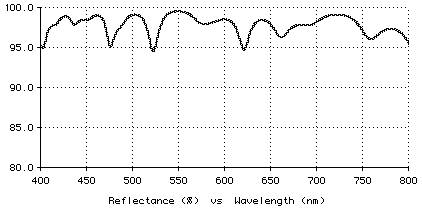
/ {9 R: t8 _6 ~5 ga = 1.3260, b = 1.0171, c = 0.7855. These values correspond to stacks centered at 729, 559, and 432 nm. The average P reflectance is about 98%. The performance for P polarization is displayed below. * `9 H4 c" a9 C* F! f: I; O+ A
 ' b1 r0 e T6 A3 R+ r' k' ?( } ' b1 r0 e T6 A3 R+ r' k' ?( }
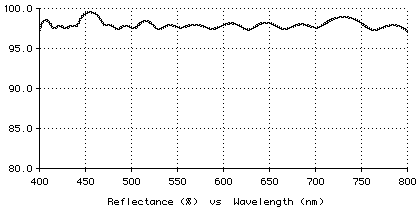
If all layers are optimized to improve the reflectance, the average P reflectance stays approximately the same; however, the minimum reflectance is substantially higher, as shown below. 4 Y s% o) u5 H) ~- U
 1 \( _* ]( M8 e4 Q" V* Z+ X5 } 1 \( _* ]( M8 e4 Q" V* Z+ X5 }
Here is the last design, with the first layer closest to the substrate and thickness given in nm.
6 F, K8 ^# t s1 X( f$ v H 97.87
/ _* g. C0 O6 ]8 e L 171.35
6 ^) }; ], I' C! t1 t7 u6 g* Z H 80.567 B$ y* t+ X4 u0 T6 _+ W& I, U6 A
L 152.15
# m7 l' n6 `. D H 74.353 u' z' s# `0 b/ x5 z4 B# _- M2 G
L 154.04
) U8 x& C4 ]) k7 s" J7 i) M P H 83.10
! t' r" |8 L C1 y9 T L 178.45# ]2 d4 D1 g9 i8 J; x2 C
H 72.02
$ _5 k& |% ?1 }7 Z6 [ L 129.75
3 w5 x) @& K. t7 Y, f2 ` H 85.36" l: [2 V D- N
L 141.64) c, ~ Z% d4 H3 Y$ V
H 82.969 B; h1 t% `# F/ s
L 141.89& z" Y% u3 L E
H 71.17, ?* K. I d. R7 |
L 137.71
+ U" M3 P( J% j7 ?9 V H 69.96
1 h1 w& R- U7 H( |2 ?* V V9 d. { L 104.04
% j* o: r$ v# S: G4 x ? H 55.42
% U5 [) k% ]4 a- W/ Q4 K# A% n L 113.898 r* C/ o, H; l8 \' L2 b
H 71.53! r8 q% |' {( L" L1 R' A
L 121.61
* ^; K7 q" h: M$ V/ ]5 o H 63.21
+ W/ r; S$ H6 j% d L 111.11) @! Z0 h2 ~/ j0 t
H 61.47. m) x6 _- G6 g, ^
L 121.697 ~% ~- p7 w/ i7 }1 h
H 63.51- ]) }3 w( W2 A( G$ G
L 101.696 h0 M' U) C/ \2 m9 A- T9 P( A
H 56.86
+ s; k* N. U9 |6 @, r L 101.16/ }7 [. y, T4 @; C. V( o0 H0 ?
H 52.26 y' N' z" Q6 R4 t& J. Q3 R
L 82.601 _& H. v& f1 C1 B4 a# X8 u \
H 46.625 Z* ]# q0 @( c9 D0 R9 @& P) g& g
L 94.22; S. M! c; n! H' R9 D. @) |
H 53.49
) U* Y" Z, y. H% `$ Z, U: i- _ L 90.92" O6 O' ?: N' ~' M/ p5 v
H 46.16$ t4 G3 f" @+ ^$ q" ~
L 86.623 }0 H' u8 {1 A2 [! o
H 51.59
! g, |9 o5 v d; i* H" Z5 \ L 91.80" R1 U! D$ f" J3 s
H 45.96" C& f" l' \2 R7 P& X( ?, Z: Z. c5 ~
L 80.640 y' H5 c+ c, g# a N6 z+ I+ W3 K0 ~
H 49.35 |

 发表于 2007-5-14 21:21:49
 提升卡
提升卡 置顶卡
置顶卡 沉默卡
沉默卡 喧嚣卡
喧嚣卡 变色卡
变色卡 抢沙发
抢沙发 显身卡
显身卡